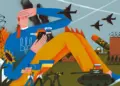

In the annals of modern warfare, victory has traditionally been measured by territorial gains, enemy casualties, and the destruction of strategic assets. Yet a quiet, blocky revolution has upended this conventional calculus. While American and Israeli forces demonstrated overwhelming kinetic superiority pulverizing Iranian military infrastructure with surgical precision the Islamic Republic quietly seized control of a different battlefield altogether: the global information space. At the heart of this unexpected triumph lies an unlikely weapon: artificial intelligence-generated videos featuring Lego-style figures. This is the story of how Iran’s “Lego War” tricked the world, outmaneuvered Western censorship, and won the propaganda war without firing a single additional missile.
The Genesis of a Digital Insurgency
The origins of Iran’s Lego propaganda campaign are deeply rooted in tragedy and strategic adaptation. Following the Minab School Attack early in the conflict an incident that claimed the lives of dozens of schoolchildren Iranian content creators faced a critical dilemma. Traditional depictions of civilian casualties risked triggering graphic content filters across major social media platforms, effectively silencing the very narratives Tehran sought to amplify. The solution was as ingenious as it was unexpected: transform the horrors of war into the universally recognizable, family-friendly aesthetic of Lego bricks.
This strategic pivot birthed what analysts now term “memetic subversion” a sophisticated campaign that blends dark humor, geopolitical grievance, and viral entertainment into a potent psychological weapon. The primary architect of this initiative, a Tehran-based collective known as Explosive Media, initially operated in relative obscurity. Launched on Telegram and Instagram in June 2025, the group produced Farsi-language content featuring human hosts, but struggled to achieve meaningful engagement. The turning point arrived on March 7, 2026, when Explosive Media pivoted to English-language, AI-generated Lego-style videos. The results were immediate and staggering.
The Architecture of Asymmetric Narrative Warfare
Understanding the success of Iran’s Lego strategy requires examining its multi-layered structure. The campaign does not rely on a single video or message but instead operates as an interconnected ecosystem of psychological operations. This architecture can be broken down into several distinct components:
A. The Satirical Deconstruction of Power
At the core of the Lego campaign lies a deliberate effort to strip away the intimidation factor surrounding Western leadership. By portraying President Donald Trump as a petulant, blocky figure often depicted crying, holding contradictory signs, or dressed in absurd costumes the videos systematically undermine the aura of authority that traditionally surrounds the American presidency. One widely circulated animation shows a Lego Trump weeping beside a document labeled “Terms of temporary ceasefire,” while another depicts him holding a “Victory” sign that, when flipped, reads “I am a loser”. This visual mockery serves a dual purpose: it entertains global audiences while subtly reframing the United States as a bumbling, ineffectual power rather than an overwhelming military force.
B. Universal Accessibility Through Visual Language
The Lego aesthetic functions as a global visual lingua franca a medium that transcends language barriers, cultural differences, and political literacy. Complex geopolitical arguments, such as the legality of the Strait of Hormuz blockade or the historical grievances surrounding American foreign policy, are distilled into easily digestible animated narratives. A viewer in Southeast Asia or South America, with no prior knowledge of Middle Eastern politics, can instantly grasp the emotional core of a video depicting Lego Iranian soldiers placing banners on missiles bearing messages like “For the people of Hiroshima and Nagasaki” or “In memory of victims of Iran Air flight 655”. This accessibility exponentially expands the potential audience far beyond those who would typically engage with conventional state propaganda.
C. The “Forbidden Fruit” Dynamic
Perhaps the most counterintuitive element of Iran’s Lego strategy is its exploitation of platform censorship. When YouTube deleted Explosive Media’s account on the grounds of promoting violence, the move backfired spectacularly. Rather than suppressing the content, the ban transformed the “Vengeance for All” series into forbidden fruit a coveted commodity that viewers actively sought out on alternative platforms like X, Telegram, Rumble, and Threads. An Explosive Media representative articulated this dynamic with defiant clarity: “We know well how the West wraps truth in silence and tries to mute every voice that speaks it”. The censorship thus became a narrative asset, reinforcing the group’s central claim that Western platforms systematically suppress dissenting perspectives.
D. Strategic Platform Diversification
Explosive Media’s operational footprint reflects a sophisticated understanding of the modern digital ecosystem. Following the initial viral success on X where Russian and Iranian state-controlled media accounts, including RT and Iran Radio PS, amplified the first Lego video within twelve hours of its release the group rapidly expanded across TikTok, Rumble, Threads, BlueSky, UpScrolled, Spotify, and SoundCloud. This multi-platform strategy ensures resilience against any single platform’s moderation policies while maximizing exposure across diverse demographic segments. Notably, TikTok emerged as the primary engine of global reach, with Explosive Media’s Lego content outpacing all other platforms in total user views.
The Psychological Hooks: Why Lego Works

The effectiveness of Iran’s Lego propaganda cannot be attributed solely to novelty or shock value. The campaign exploits several deep-seated psychological mechanisms that make its messages uniquely persuasive and shareable.
A. Humor as a Trojan Horse
Traditional state propaganda grim, didactic, and unmistakably political struggles to penetrate the attention economy of algorithmic feeds. Iran’s Lego videos, by contrast, are genuinely entertaining. They feature bespoke rap beats, dramatic musical scores, and comedic timing that rivals professional animation studios. This entertainment value serves as a Trojan horse: viewers share the videos because they are funny or visually impressive, often with little conscious awareness that they are simultaneously consuming sophisticated geopolitical messaging. As one analysis noted, these videos are “designed less like political messaging and more like social media entertainment”.
B. Emotional Resonance Through Symbolism
Explosive Media’s animations are saturated with layered symbolism that rewards attentive viewers while remaining accessible to casual ones. The group’s spokesperson explained that the recurring green and red color palette carries deep meaning: green represents Hussain, the grandson of Prophet Mohammed and his fight for justice against oppression, while red symbolizes the oppressor. For Shia Muslim audiences, these visual cues evoke centuries of religious narrative and communal identity. For secular Western viewers, the same colors simply create aesthetically striking contrasts. This dual encoding allows the same content to operate on multiple interpretive levels simultaneously.
C. Exploiting Institutional Friction
The Lego campaign has exposed a fundamental vulnerability in Western information operations: the difficulty of responding to absurdist provocations without appearing humorless or oppressive. The Pentagon’s Information Operations cell has reportedly struggled to formulate effective counter-messaging. Directly refuting a Lego video risks legitimizing its claims and amplifying its reach; ignoring it allows the narrative to metastasize unchallenged. This institutional friction creates a strategic paralysis that Iran’s content creators exploit with evident relish. Every official American response, whether dismissive or defensive, becomes fresh material for the next round of mockery.
The Broader Ecosystem: Beyond Explosive Media
While Explosive Media serves as the most visible node in Iran’s Lego propaganda network, it is far from the only actor. The campaign operates as a decentralized ecosystem involving multiple Iran-aligned AI studios, state-linked social media accounts, and sympathetic independent creators. Iranian diplomatic missions have also embraced meme warfare, with the Iranian embassy in Zimbabwe famously responding to Trump’s demands regarding the Strait of Hormuz with the deadpan quip: “we’ve lost the keys”. This integration of formal diplomatic channels with informal, humor-driven content creates a surround-sound effect, saturating global discourse with Iranian perspectives across every conceivable venue.
Narrative Power Versus Structural Reality
The success of Iran’s Lego campaign raises profound questions about the relationship between narrative influence and material power. On one level, the strategy has been undeniably effective: Iran has “won the narrative” among global youth and anti-war activists, shaping perceptions of the conflict in ways that favor Tehran’s position. The videos have garnered hundreds of thousands of views on X alone, with mirror-views across alternative platforms likely numbering in the millions. In the attention economy, these are significant victories.
Yet a crucial paradox remains. Despite its narrative triumphs, Iran has not altered the “kinetic reality” of American military dominance or the structural weight of the blockade. Lego videos cannot open the Strait of Hormuz, rebuild destroyed missile facilities, or reverse the degradation of Iran’s security apparatus. This divergence between narrative power and structural power represents one of the defining tensions of twenty-first-century conflict. The question that haunts Tehran’s strategists is whether winning hearts and minds or at least capturing eyeballs and algorithmic engagement can compensate for losing territory, infrastructure, and military capability.
Implications for Future Conflict
The Iranian Lego experiment offers several lessons that military planners, information warfare specialists, and political communicators would be wise to internalize. These lessons can be organized as follows:
A. The Attention Economy Is the New Battleground
In an era of infinite content, propaganda must compete not only against opposing propaganda but against sports highlights, celebrity gossip, and cat videos. A carefully reasoned policy paper may be strategically sound, but if it fails to capture attention, it is functionally irrelevant. Iran’s Lego videos succeed because they are optimized for virality first and persuasion second and paradoxically, this optimization makes them more persuasive.
B. Low-Cost, High-Impact Tools Are Democratizing Influence
The AI tools required to produce Lego-style animations are commercially available and increasingly inexpensive. This technological democratization means that state and non-state actors alike can produce professional-quality content without traditional media infrastructure. The era of propaganda being the exclusive province of well-funded government agencies is over.
C. Censorship Can Be Counterproductive
Platform moderation policies designed to suppress “harmful” content may inadvertently amplify it. The YouTube ban on Explosive Media transformed the group’s content into a symbol of resistance, driving audiences to seek out the “forbidden” material. Information operations specialists must weigh the risks of censorship against the potential for Streisand effects.
D. Humor Is a Strategic Asset
The Iranian campaign demonstrates that humor is not antithetical to serious geopolitical messaging it is a force multiplier. Laughter lowers defenses, builds rapport, and creates emotional investment. Western information operations, often characterized by earnestness and moral seriousness, may need to embrace a lighter touch.
Conclusion: The Blocky Future of Warfare

Iran’s Lego War trick represents far more than a clever social media stunt. It signals a fundamental transformation in how conflicts are fought, perceived, and remembered. While bombs destroy buildings and missiles eliminate personnel, Lego bricks animated, algorithmically optimized, and culturally intelligent construct narratives that shape what millions of people believe about who is winning, who is righteous, and who deserves sympathy. The Islamic Republic may have lost the kinetic battle, but in the server farms where truth is animated one block at a time, it has achieved something remarkable. The world’s militaries are watching, and the next war may well be won not by the side with the most advanced weapons, but by the side with the most compelling story and the best animators.