War has always been fought on multiple fronts. Bullets and bombs dominate the battlefield, but the battle for hearts and minds has proven equally decisive throughout history. From crude leaflets dropped behind enemy lines to sophisticated radio broadcasts during the Cold War, propaganda has long served as a force multiplier for military objectives. Today, however, something unprecedented is unfolding. A new form of warfare has emerged that does not require soldiers, tanks, or missiles. It operates through algorithms, generative artificial intelligence, and the infinite scroll of social media feeds. Its weapon is not destruction but distraction, not death but doubt. This phenomenon has been given a name that perfectly captures its absurd yet dangerous nature: slopaganda.
The term represents a fusion of two distinct concepts that have collided in the digital age. On one side sits “AI slop” the endless flood of low-quality, machine-generated content that clogs social media platforms with bizarre images, nonsensical videos, and hollow engagement bait. On the other side stands “propaganda” the deliberate manipulation of beliefs, emotions, and behaviour to achieve political objectives. When these two forces merge, the result is something far more potent than either could achieve alone. Slopaganda is not merely annoying internet noise; it represents a fundamental shift in how influence is exercised, how conflicts are narrated, and how public opinion is shaped in the twenty-first century.
This article examines the rise of slopaganda as a new instrument of war, exploring its origins, defining characteristics, real-world applications, and the profound implications it holds for societies navigating an increasingly fragmented information environment. Understanding this phenomenon is no longer optional for citizens, policymakers, journalists, or anyone who consumes news through digital platforms. The battle for cognitive sovereignty has already begun, and the weapons are being generated at this very moment.
Defining Slopaganda: More Than Just Junk Content
To comprehend what makes slopaganda so significant, one must first understand the individual components that constitute it. The concept of “AI slop” emerged as generative artificial intelligence tools became widely accessible, enabling anyone with a computer and an internet connection to produce vast quantities of text, images, video, and audio with minimal effort or skill. Unlike earlier forms of user-generated content that required at least some creative capacity, AI slop represents the algorithmic equivalent of spam content produced not because someone wanted to create it, but simply because the technology made it possible and the economics of engagement made it profitable.
Slopaganda takes this raw material and weaponises it. The term was coined by researchers Michał Klincewicz, Mark Alfano, and Amir Ebrahimi Fard in a 2025 academic paper, though it quickly escaped the confines of academia and entered popular discourse. Their definition is precise but expansive: slopaganda refers to AI-generated content specifically designed to manipulate beliefs, emotions, and political decision-making at scale. The key word here is “designed” while AI slop may be produced indifferently for commercial purposes or simply to farm clicks, slopaganda is deployed with deliberate political or ideological intent.
This distinction matters because it separates slopaganda from mere misinformation or accidental falsehoods. A viral video containing incorrect information may spread because people find it compelling, but slopaganda is created precisely because someone understands what will capture attention and provoke a response, and they exploit that knowledge systematically. The creators of slopaganda do not necessarily care whether their content is believed in a factual sense. What matters is that it is seen, shared, reacted to, and remembered. In this sense, slopaganda operates on an emotional and psychological level rather than an evidentiary one.
How Slopaganda Differs from Traditional Propaganda
Every major technological revolution in communication has been harnessed for persuasive purposes. The printing press enabled the mass distribution of political pamphlets. Radio allowed governments to reach citizens directly in their homes. Television brought visual imagery into the fabric of political campaigns. Each new medium brought new possibilities for manipulation alongside new opportunities for education and enlightenment. Yet slopaganda represents a qualitative leap rather than a mere quantitative expansion of existing propaganda techniques.
A. Unprecedented Scale and Speed
Traditional propaganda, even at its most industrialised, required human labour. Teams of writers, artists, and producers created materials that were then distributed through controlled channels. The volume of content that could be produced and disseminated was limited by the number of people available to create it and the capacity of distribution networks to carry it. Slopaganda demolishes these constraints entirely. A single operator with access to generative AI tools can produce dozens of pieces of content in an hour, each tailored to different platforms, demographics, or emotional registers. The cost approaches zero, and the supply is effectively infinite.
This has profound implications for the information ecosystem. Where fact-checkers and journalists must carefully verify claims before publishing corrections, slopaganda generators can flood the zone with hundreds of alternative narratives within minutes. The asymmetry between production and refutation sometimes called Brandolini’s Law reaches its logical extreme when machines generate fakes faster than humans can possibly debunk them. Researchers studying the phenomenon have noted that slopaganda pushes this imbalance to unprecedented levels, overwhelming the capacity of traditional verification mechanisms.
B. Micro-Targeting and Personalisation
Traditional propaganda generally addressed a mass audience with a uniform message. While propagandists understood the importance of tailoring content to different segments of society, the practical limitations of media technology meant that most messages were broad and general. Slopaganda operates differently. Generative AI can produce personalised content at scale, creating variations of images, videos, and texts designed to resonate with specific individuals or narrow demographic groups based on their estimated beliefs and emotional vulnerabilities.
This micro-targeting capability means that two people living in the same neighbourhood might see completely different versions of the same conflict, each calibrated to reinforce their existing prejudices or provoke their particular anxieties. The shared reality that enables democratic deliberation the notion that citizens are responding to roughly the same set of facts erodes further with each personalised message.
C. The Intent to Blend In, Not Convince
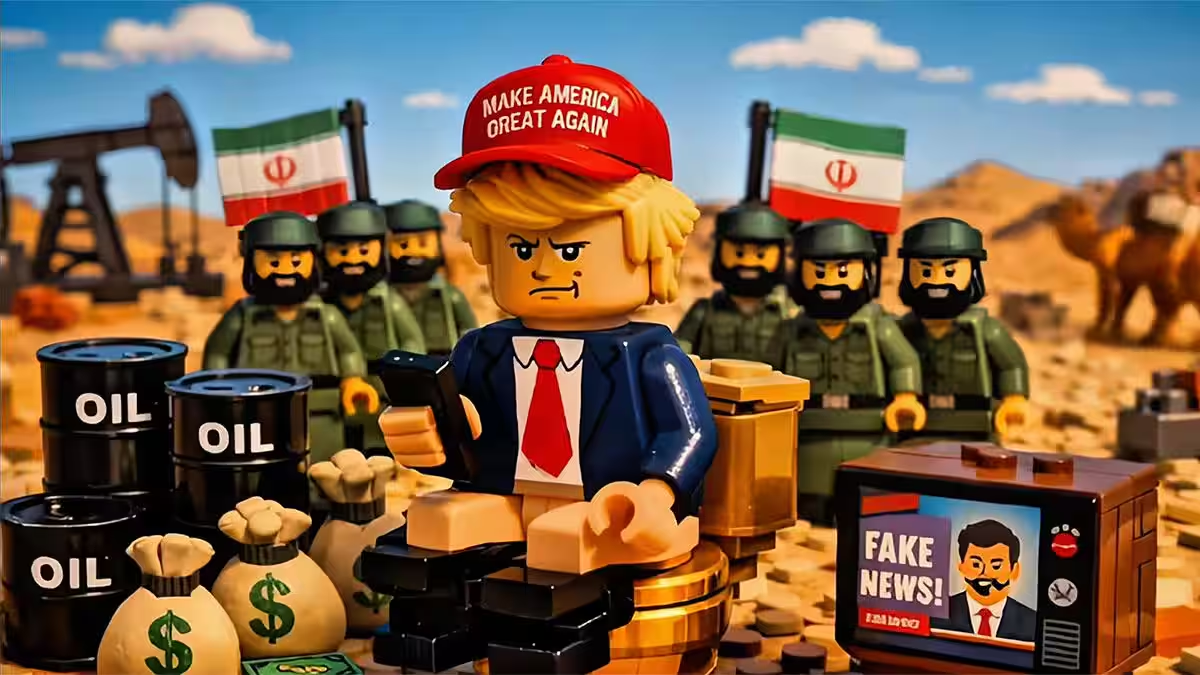
Perhaps the most insidious feature of slopaganda is that it often does not attempt to persuade through argumentation. Traditional propaganda typically presented reasons, however spurious, for accepting a particular worldview. Slopaganda, by contrast, frequently abandons the pretense of factual accuracy altogether. It is “expressive rather than truth-apt,” designed to create emotional associations rather than false factual beliefs. A Lego-figurine version of a political leader being humiliated does not claim to depict a real event; it exists to make viewers feel amusement, contempt, or solidarity. The emotional residue it leaves behind is the goal, not any specific factual claim.
This shift from persuasion to emotional modulation is crucial. When propaganda tries to convince, it can be countered with evidence and argument. When it instead seeks to create a mood, a feeling of us-versus-them, or a sense of absurdist entertainment, the tools of rational counter-argument become largely irrelevant. Slopaganda slips through the mental defences that people have developed against obviously manipulative messages precisely because it does not present itself as serious or authoritative.
Slopaganda in Action: The US-Iran Conflict

The most prominent laboratory for slopaganda in recent years has been the escalating information conflict between the United States and Iran, conducted alongside and sometimes independently of actual military hostilities. This conflict has provided a rich case study in how AI-generated content is deployed as a weapon of narrative warfare.
In October 2025, then-President Donald Trump posted an AI-generated video depicting himself piloting a fighter jet while wearing a crown and dropping faeces on American protesters. This was not a conventional political advertisement or even a standard piece of propaganda. It was, in essence, an AI-generated meme elevated to the level of presidential communication. The content was absurd, deliberately offensive, and designed not to persuade anyone of any political position but to signal a particular attitude contemptuous, irreverent, and aggressive to supporters and opponents alike.
Iranian actors responded in kind, and the response proved even more effective in terms of engagement metrics. Pro-Iranian content creators produced a series of AI-generated videos in the style of Lego animations, depicting Trump, Jeffrey Epstein, Satan, Benjamin Netanyahu, and other figures as animated plastic figurines. These videos were shared by official Iranian diplomatic accounts, state media, and a network of sympathetic social media users, accumulating tens of millions of views.
What made these Lego videos so effective was not any particular factual claim they advanced. Viewers were not expected to believe that Trump had literally been transformed into a Lego figure. Instead, the videos worked through humour, ridicule, and aesthetic appeal. They made the targets appear absurd, undermining their perceived dignity and authority. In a conflict where perceptions of strength and legitimacy matter enormously, the ability to make an adversary look ridiculous and to have that ridicule spread virally across global platforms – constitutes a genuine strategic asset.
The conflict also demonstrated the blurring of boundaries between state and non-state actors in the slopaganda ecosystem. Some of the most viral content was produced by individuals with no formal connection to any government, yet it was eagerly amplified by official accounts once it began gaining traction. This creates a form of plausible deniability: governments can benefit from propaganda without having commissioned it, simply by recognising effective content and helping it spread.
The Russia-Ukraine Information Front
The conflict in Ukraine has served as another crucial testing ground for slopaganda techniques, with both sides deploying AI-generated content to shape international perceptions of the war. Researchers at the University of Amsterdam examined pro-Russian TikTok memes that blended propaganda with internet culture so seamlessly that distinguishing between the two became nearly impossible. These videos did not present themselves as official communications from a government or military organisation. They appeared instead as organic expressions of online culture humorous, meme-like, and deeply integrated with the aesthetic norms of the platforms on which they circulated.
This integration with platform culture is a defining feature of slopaganda. Where traditional propaganda often struggled to adapt to new media environments, slopaganda is native to them. It understands the rhythms of algorithmic distribution, the aesthetics that drive engagement, and the emotional registers that trigger shares and comments. A video that looks like a piece of entertainment is more likely to be consumed and spread than one that announces itself as a political message, even if the entertainment is designed to achieve political effects.
The consequences for audiences are significant. When propaganda is indistinguishable from entertainment, when the boundaries between information and amusement dissolve, the cognitive habits that support democratic citizenship critical evaluation, source assessment, deliberate reflection become increasingly difficult to sustain. Users share content not because they believe it is true, but because it is funny, striking, or trending. Each share, however, contributes to the normalisation of particular narratives and the marginalisation of others.
Why Slopaganda Works: The Psychology of Attention
The effectiveness of slopaganda cannot be explained solely by the technology that makes it possible. It also exploits fundamental features of human psychology, particularly the ways in which attention, memory, and emotion interact in digital environments. Understanding these psychological mechanisms is essential for anyone hoping to resist the influence of slopaganda or to develop countermeasures against it.
A. Emotional Hijacking
Slopaganda is designed to be emotionally arresting. Negative emotions fear, anger, disgust are particularly effective at capturing and holding attention, a fact well established in psychological research. Content that provokes these emotions is more likely to be shared, commented upon, and remembered than content that is neutral or mildly positive. Slopaganda creators understand this intuitively and craft their content to trigger the strongest possible emotional responses with the least possible effort. A single AI-generated image can provoke outrage or amusement in seconds, and that emotional reaction is the currency of the attention economy.
B. Repetition and Familiarity
Even obviously false or absurd content can shape perceptions if encountered frequently enough. The mere exposure effect the psychological tendency to develop preference for things simply because they are familiar operates powerfully in digital environments where the same narratives circulate repeatedly across multiple platforms. Slopaganda achieves frequency with minimal effort, ensuring that particular images, phrases, and associations become part of the background noise of online life. Over time, this repetition can subtly shift what feels normal, plausible, or acceptable, even without any conscious acceptance of specific claims.
C. Cognitive Overload
The sheer volume of slopaganda contributes to its effectiveness by overwhelming the cognitive resources that individuals would need to evaluate it critically. When confronted with hundreds of images and videos, most people default to heuristic processing quick, automatic judgments based on surface features rather than deep analysis. Slopaganda is designed to exploit these heuristics, presenting content that feels authentic, entertaining, or emotionally satisfying without requiring verification. The cognitive burden of questioning every piece of content encountered online is simply too great for most people to sustain.
Implications for Democracy and Public Discourse
The rise of slopaganda poses challenges that extend far beyond any particular conflict or election. At its core, democratic governance depends on the existence of a shared informational environment in which citizens can engage in reasoned debate about collective problems. This does not require universal agreement on facts, but it does require some baseline of common reference points and a shared commitment to distinguishing between truth claims that can be evaluated and those that cannot.
Slopaganda erodes this foundation in several ways. It floods the information ecosystem with content designed to provoke rather than inform, making it increasingly difficult for citizens to identify reliable sources or to engage in the kind of deliberate reflection that democratic participation requires. It weaponises the emotional triggers that drive social media engagement, ensuring that the most inflammatory and polarising content receives the greatest visibility. And it exploits the trust that people place in their social networks, using the mechanics of sharing and recommendation to spread narratives that may be entirely disconnected from reality.
The consequences are already visible in the political life of many countries. Elections are contested not just on policies but on competing versions of reality. Public health measures are undermined by viral misinformation. International conflicts are fought not only with weapons but with competing narratives that shape how different audiences understand what is happening and who is responsible. Slopaganda accelerates and intensifies these dynamics, making the information environment more chaotic, more manipulative, and more resistant to correction.
Countering Slopaganda: Strategies and Limitations
Addressing the challenge of slopaganda requires a multi-faceted approach that recognises both the scale of the problem and the limits of any single solution. Technological fixes alone are insufficient, as are purely educational approaches or regulatory measures. What is needed is a comprehensive strategy that combines platform accountability, media literacy, journalistic vigilance, and broader societal resilience.
A. Platform Responsibility
Social media platforms play a central role in the slopaganda ecosystem, providing both the infrastructure for distribution and the algorithmic systems that determine what content reaches which audiences. Platforms have a responsibility to implement policies that reduce the spread of deliberately manipulative content, including AI-generated propaganda, without becoming arbiters of truth in ways that could be abused. This is a difficult balance to strike, but the status quo in which algorithmic amplification rewards the most emotionally manipulative content regardless of its accuracy or intent – is clearly untenable.
B. Media Literacy and Critical Thinking
Education and awareness remain essential tools in the fight against slopaganda. Citizens who understand how generative AI works, who recognise the techniques of emotional manipulation, and who have developed habits of critical evaluation are less vulnerable to slopaganda’s effects. However, media literacy alone cannot solve the problem. The volume and sophistication of slopaganda make it unrealistic to expect individuals to verify every piece of content they encounter. Media literacy must be accompanied by broader structural changes.
C. The Limits of Fact-Checking
Traditional fact-checking, while valuable, struggles to keep pace with slopaganda. The asymmetry between the ease of producing false content and the difficulty of verifying it means that fact-checkers are always playing catch-up. Moreover, fact-checking addresses factual claims, while much slopaganda deliberately avoids making verifiable claims at all. New approaches are needed that focus not just on individual pieces of content but on the networks, accounts, and incentives that drive the production and spread of slopaganda.
Conclusion: Warfare Transformed

Slopaganda represents more than just a new term for an old phenomenon. It marks a genuine transformation in how influence is exercised, how conflicts are narrated, and how public opinion is shaped. The combination of generative AI’s productive capacity with the distribution dynamics of social media has created a form of propaganda that is faster, cheaper, more targeted, and more difficult to counter than anything that came before. It thrives on attention, exploits emotion, and flourishes in the gaps left by traditional verification mechanisms.
The conflicts between the United States and Iran, and between Russia and Ukraine, have provided early demonstrations of slopaganda’s potential. But these are only the beginning. As generative AI tools become more sophisticated and accessible, and as social media platforms continue to dominate the global information environment, slopaganda will become an increasingly prominent feature of political communication in contexts far beyond the battlefield.
Recognising slopaganda for what it is not merely annoying internet noise, but a deliberate strategy of influence deployed by state and non-state actors alike is the first step toward developing effective responses. The second step is building resilience at every level: individual, institutional, and societal. The war for attention and belief is already underway. Understanding the weapons being used in that war is no longer optional; it is a prerequisite for informed citizenship in the twenty-first century.