

The intersection of artificial intelligence, social media, and geopolitical conflict has produced one of the most bizarre yet effective propaganda campaigns in modern history. Pro-Iranian content creators have weaponized the universally recognizable Lego aesthetic to wage a psychological war against President Donald Trump and his administration, creating a phenomenon that experts have dubbed “slopaganda” a portmanteau of “slop” and “propaganda” that perfectly captures the surreal nature of this digital offensive.
What began as seemingly harmless animated clips has evolved into a sophisticated information warfare operation that has generated hundreds of millions of views across social media platforms, forcing YouTube to intervene and ban one of the primary accounts responsible for producing this content. This article examines the origins, mechanisms, and implications of this unprecedented fusion of pop culture, artificial intelligence, and international conflict.
The Rise of Slopaganda
Traditional wartime propaganda followed a predictable formula: governments issued formal posters, commissioned serious films, and broadcast carefully scripted speeches through state-controlled media channels. This approach was unmistakably political, and audiences immediately recognized when they were being fed a particular narrative.
The Iran war has shattered this conventional model entirely. Modern propaganda must now compete in what media analysts call the “attention economy” a chaotic digital marketplace where geopolitical messaging battles against sports highlights, celebrity gossip, and viral entertainment for scarce viewer attention. A perfectly reasoned diplomatic statement may be strategically sound, but if nobody watches it, its practical impact is negligible.
Slopaganda represents an evolutionary adaptation to these new conditions. By wrapping political messages in the familiar, non-threatening aesthetic of Lego animation complete with AI-generated hip-hop soundtracks and dramatic cinematic framing these videos bypass the psychological defenses that audiences typically deploy against overt propaganda. Viewers who would instinctively scroll past a formal government statement find themselves captivated by what appears to be harmless animated entertainment, only to absorb deeply partisan narratives about the conflict.
Experts emphasize that dismissing this phenomenon as childish or unserious would be a critical mistake. Technology consultant Dr. Lukasz Olejnik warned that attention has become “the primary resource in any conflict, including wars,” and that states are increasingly abandoning traditional “dusty” forms of diplomacy in favor of approaches that capture modern audiences.
Inside the Explosive Media Operation
At the center of this digital propaganda campaign sits Explosive Media, a small operation that has achieved remarkable reach despite its limited resources. The group, which produces content under the banner of “Mr. Explosive,” has been identified by BBC journalists as being commissioned by the Iranian regime, though its leader maintains a carefully crafted veneer of independence.
The mysterious figure behind Explosive Media identified only as “Mr. Explosive” has given rare interviews to journalists, appearing in footage illuminated by the colors of the Iranian flag. His stated motivation is straightforward: “It is an honor to work for my homeland”. When pressed about the nature of his relationship with the Iranian government, he initially described Explosive Media as an “independent” outlet, but later admitted that the Iranian regime commissions his team’s work.
Perhaps most striking is the operational scale of this propaganda effort. Mr. Explosive claims his team consists of fewer than ten individuals, yet this tiny operation has achieved reach that surpasses many state-run media organizations. Daily content production is professionally executed and algorithmically optimized for maximum engagement, demonstrating a sophisticated understanding of how digital platforms reward shareable content.
The content produced by Explosive Media covers a wide range of provocative scenarios. One video depicts a baby Trump “playing war” on the floor of the Oval Office. Another shows the president examining the Epstein files alongside a devil figure. Yet another portrays Trump as a Lego mini-figure sobbing at his failed ceasefire while holding a white flag and eating a taco a sardonic reference to the acronym “Trump Always Chickens”.
A. The Visual Language of Lego Propaganda

The choice of Lego as a medium is far from arbitrary. Mr. Explosive explained that his team generates Lego content “because it is a world language”. The Danish toy company’s aesthetic is universally recognized across cultures and generations, providing an instantly accessible visual framework that transcends linguistic and cultural barriers.
B. Bypassing Content Moderation
The seemingly innocent nature of Lego animation also serves a strategic purpose: it helps content evade the scrutiny of platform moderators and algorithmic content filters. A video featuring a Lego figure performing violent actions is less likely to be flagged as sensitive political content than footage of real violence or explicit political messaging.
C. Cognitive Dissonance as a Tool
There is a profound cognitive dissonance at work in these videos. The same visual language that children associate with innocent playtime is used to depict dying children, fighter jets, and political humiliation. This jarring juxtaposition forces viewers to process disturbing content through an unexpected lens, making the underlying messages more memorable and emotionally impactful.
D. Algorithmic Optimization
The creators of these videos understand that social media algorithms reward engagement, not accuracy or fairness. By creating content that provokes strong emotional reactions laughter, outrage, curiosity they ensure their videos are shared, commented upon, and amplified by the platforms themselves.
The Epstein File Connection
Many of the most viral Lego videos connect Trump’s decision to launch military action against Iran with his desire to distract public attention from his alleged connections to disgraced financier Jeffrey Epstein. This narrative, whether factually grounded or not, resonates with audiences already skeptical of official justifications for war.
One particularly striking video shows a Lego Trump becoming enraged after viewing the “Epstein files,” then pressing a red button that launches a missile attack on Iran. The implication is clear: the war serves as a convenient distraction from domestic scandals. This messaging strategy exploits existing political divisions and conspiracy theories, weaving them into a coherent (if simplified) narrative about American foreign policy.
The videos also frequently depict Israeli Prime Minister Benjamin Netanyahu as manipulating Trump, reinforcing a narrative that the Iran conflict serves Israeli interests rather than American ones. Some clips go further, employing imagery that experts have identified as drawing directly from classical antisemitic tropes, including a blood-drinking Netanyahu and devil figures bearing the Star of David.
Mr. Explosive has rejected accusations of antisemitism, characterizing such depictions as “necessary exaggeration” for dramatic effect. When confronted with factual inaccuracies such as a video showing an American pilot being captured by Iranian forces when he was actually rescued by US special forces he deflected by claiming that “only 13 percent of what Mr. Trump says is based on facts”.
YouTube’s Ban and Its Implications
The growing influence of Explosive Media’s content prompted YouTube to take decisive action. The platform terminated the group’s channel on March 27, citing violations of its policies on spam, deceptive practices, and scams. The suspension sparked immediate backlash from Iranian officials, who characterized the move as an attempt to “suppress the truth” about what they describe as an illegal American war.
A. Iran’s Official Response
Iranian Ministry of Foreign Affairs spokesman Esmaeil Baghaei condemned the ban, arguing that YouTube was acting “simply to suppress the truth about their illegal war on Iran and shield the American administration’s false narrative from any competing voice”.
B. The Ban’s Effectiveness
The ban has proven only partially effective. While Explosive Media’s primary YouTube presence has been eliminated, the group’s content continues to circulate on Instagram, TikTok, and X (formerly Twitter), where it remains easily accessible to millions of users. This demonstrates the fundamental challenge of regulating propaganda in an era of decentralized social media platforms.
C. Platform Accountability Questions
The incident raises uncomfortable questions about the role of technology companies in moderating political content during international conflicts. YouTube’s decision to ban a channel for “violent content” a characterization Explosive Media openly mocked highlights the subjective nature of content moderation decisions and the potential for accusations of political bias from all sides.
The Attention Economy and Propaganda Evolution
The success of Explosive Media’s Lego videos illustrates a fundamental shift in how propaganda operates in the digital age. The videos are designed less like traditional political messaging and more like social media entertainment. They prioritize shareability, emotional impact, and algorithmic optimization over factual accuracy or logical persuasion.
A. Virality Over Persuasion
Modern propaganda is no longer judged solely by how persuasive or factually grounded it is. Increasingly, it must compete in the attention economy, where the currency is engagement and the battlefield is algorithmic feeds.
B. The Role of AI in Democratizing Propaganda
Artificial intelligence tools have dramatically lowered the barriers to entry for sophisticated content creation. What once required teams of animators, editors, and sound designers can now be accomplished by a small group with access to AI-powered creative tools. This democratization of propaganda production has profound implications for information warfare, allowing smaller actors to compete with state-level media operations.
C. Exploiting the Tools of the Enemy
Analysts have noted with some irony that Iranian propagandists are using AI tools “developed and deployed in data centers in the United States” to undermine American foreign policy objectives. This technological blowback highlights the complex and often contradictory nature of global information ecosystems.
D. The Memeification of Geopolitics
The Lego videos represent a broader trend toward the memeification of geopolitics, where complex international conflicts are reduced to shareable visual gags and catchy slogans. While this approach may be effective at capturing attention, it raises concerns about the capacity for nuanced public discourse on matters of war and peace.
Psychological Operations or Political Satire?
The question of whether Explosive Media’s content constitutes legitimate political satire or dangerous psychological operations is not merely academic. The answer has implications for how platforms should moderate such content and how societies should understand the information they consume.
A. The Satire Defense
Mr. Explosive frames his work as a form of political satire, comparable to Western late-night comedy shows that routinely mock political leaders. From this perspective, the Lego videos are simply using humor to critique power and expose what the creators perceive as American hypocrisy.
B. The Propaganda Reality
However, the direct commissioning of content by the Iranian regime complicates this defense. When a foreign government pays for content designed to influence public opinion in another country, the “satire” label becomes a thin veneer over what is functionally a state-sponsored information operation.
C. The Expert Consensus
Experts in Iranian culture Kevin L. Schwartz and Olmo Gölz have noted that Iran’s willingness to employ meme videos in its propaganda efforts should come as no surprise. They explained that this approach is “on-brand for the Islamic Republic,” reflecting a binary worldview that casts global politics as a confrontation between “the oppressed and the oppressors”.
Broader Implications for Information Warfare
The Lego Trump phenomenon represents a watershed moment in the evolution of digital propaganda. It demonstrates how artificial intelligence, pop culture, and social media algorithms can be combined to create powerful messaging that reaches millions of people while evading traditional content moderation.
A. The New Propaganda Playbook
The success of Explosive Media suggests that future information operations will increasingly rely on entertainment formats, AI-generated content, and platform-specific optimization rather than traditional propaganda techniques.
B. Challenges for Platform Regulation
The case highlights the difficulty platforms face in distinguishing between legitimate political speech, satire, and state-sponsored disinformation. The subjective nature of these categories means that any moderation decision will inevitably be criticized as biased by one side or the other.
C. Implications for Democratic Discourse
Perhaps most concerning is the implication for democratic discourse. When the same techniques used to sell products and entertain audiences are deployed to shape public opinion on matters of war and peace, the line between information and manipulation becomes dangerously blurred.
D. The Arms Race Dynamic
As AI tools become more accessible and sophisticated, we can expect an escalating arms race between propaganda producers and platform moderators. The Lego videos are likely just the beginning of a new era in which anyone with a laptop and an internet connection can produce content capable of influencing global events.
Conclusion
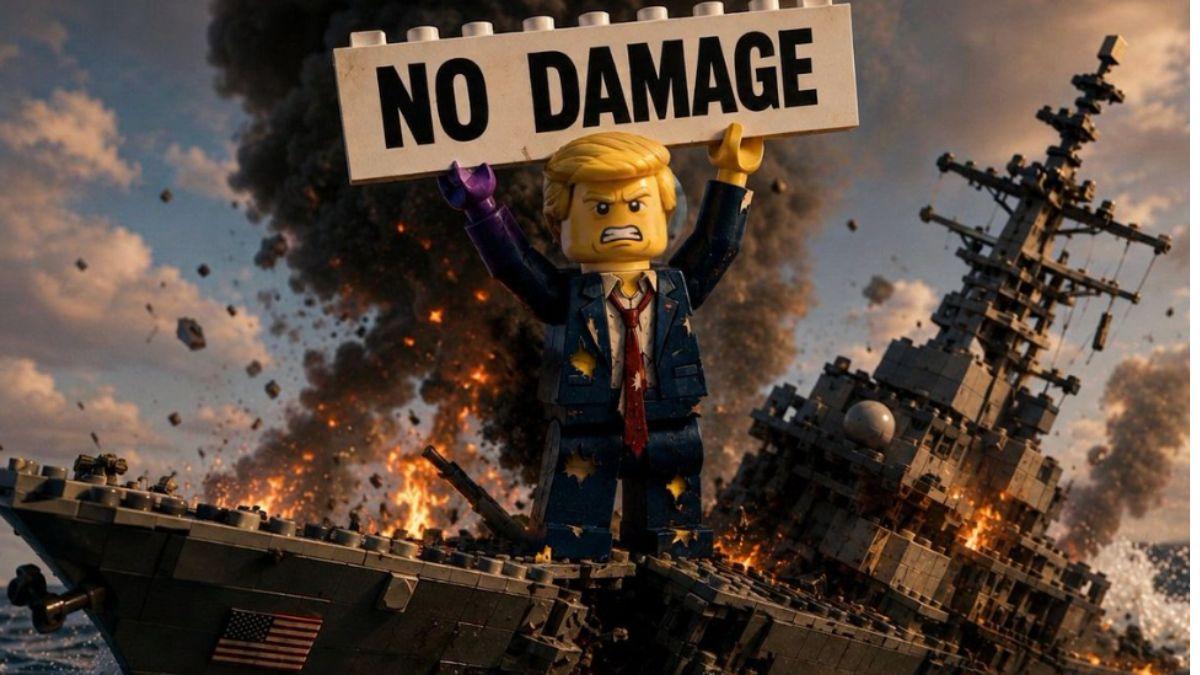
The “Lego Trump war trick” is far more than a curiosity of the digital age. It represents a fundamental transformation in how propaganda operates, how information wars are fought, and how public opinion is shaped in the twenty-first century. The fusion of artificial intelligence, universal pop culture iconography, and algorithmic distribution has created a new form of political messaging that is simultaneously entertaining, emotionally resonant, and potentially dangerous.
The small team behind Explosive Media has demonstrated that a handful of creative individuals equipped with modern AI tools can achieve reach and influence that rivals traditional state media operations. Their Lego videos have been viewed hundreds of millions of times, penetrating public consciousness in ways that conventional propaganda could never achieve.
YouTube’s decision to ban the primary account represents a recognition of this new reality, but also an admission of its limitations. The content continues to circulate on other platforms, and the techniques and tools that produced it remain widely available. The genie of AI-powered slopaganda cannot be put back in the bottle.
For audiences, the challenge is to develop new forms of media literacy that can recognize propaganda even when it arrives wrapped in the innocuous packaging of toy animations and meme culture. For platforms, the challenge is to develop moderation approaches that can distinguish between entertainment, satire, and state-sponsored manipulation without becoming arbitrary arbiters of truth. For governments, the challenge is to understand that the battlefield of the future is not just physical terrain but the attention and beliefs of populations worldwide.
The Lego Trump war trick exposed a vulnerability in the information ecosystem that adversaries are already exploiting. Whether democratic societies can adapt to this new reality remains one of the most pressing questions of our time. The plastic bricks may be toys, but the war they are being used to fight is very real.